The short answer
You need a permit from the City of Pompano Beach to rent out a home for less than thirty days at a time.
Getting it means collecting ten separate items from four different government offices, drawing two maps of your property, signing two statements in front of a notary, and passing a city inspection.
Plan on about $1,000 in government fees the first year. Plan on four to eight weeks the first time, because six of the ten items come from other agencies that each move at their own speed.
And one rule stops a lot of owners cold: the city requires a real person who lives within twenty-five miles of the house and answers the phone at any hour. If you live out of state, you cannot do this part alone.
That is the intimidating version. Before you close the tab: this is paperwork, not rocket science. We worked it out ourselves with nobody to ask, and there is nothing in here you need a degree for. Read on and it turns into a list.
Why the city asks for all of this
Here is the thing that makes the whole application make sense.
Most of what Pompano Beach asks for is not about your house at all. It is about whether everybody else has already been paid.
The state wants to know you are registered to collect sales tax. The county wants to know you have a tourist tax account and a business tax receipt. The city wants its own business tax receipt, and it wants proof you do not owe money on any property you already own here.
Only after all of that does anyone ask about bedrooms and fire extinguishers.
So the city is really the last checkpoint in a line. It will not stamp anything until it can see that everyone upstream already has you on their list and is getting their cut. We are not going to call this an arrangement between capos, partly because it is not one, and mostly because we would like our own permit renewed next year.
But it does explain the structure. And it explains why doing this in the wrong order costs you a month.
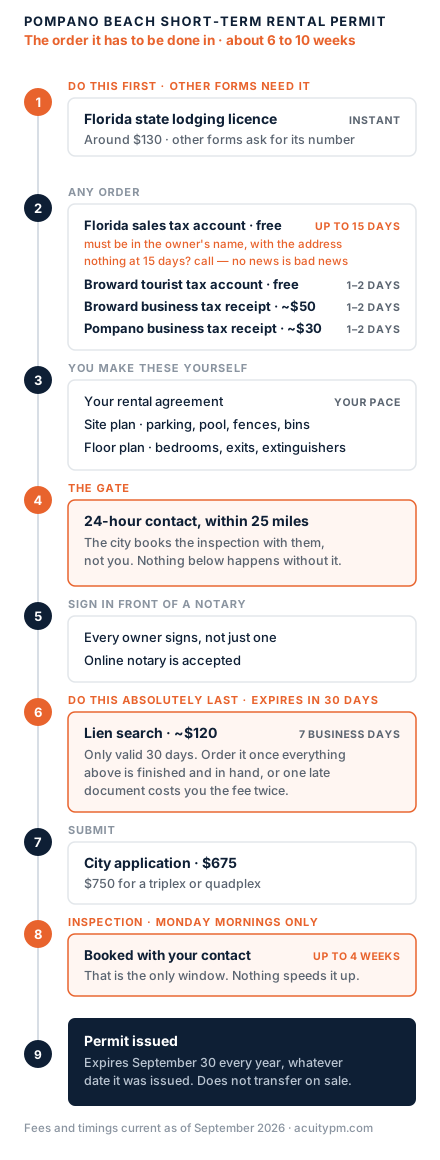
Here is the whole thing on one screen. The rest of this article is just these nine boxes explained.
The six quests you have to finish first
These are the prerequisites. Each one is a separate thing you go get, from a separate office, and a copy of each gets stapled to your city application.
This is the part nobody warns you about. If you print the city's form and start at the top, you will reach the bottom and realize you cannot hand in anything, because six of the boxes are documents you were supposed to already have.
Two of them are order-critical, and they are the bookends.
The state lodging license goes first, because it takes the longest and everything else can run while you wait on it.
The lien search goes absolutely last, because it expires. More on that below, but if you remember one thing from this article, make it that one.
1. A state lodging license. From the Florida Department of Business and Professional Regulation. The official name is a "transient public lodging establishment" license, which is a long way of saying "people sleep here and then leave." About $130.
Start with this one. It takes the longest, and everything else can happen while you wait.
2. A Florida sales tax account. From the Department of Revenue. Free to open.
Read this part twice. The certificate has to be in the property owner's name and show the property address. If you registered under your company name, or the address is missing, the city sends your application back. This is the single most common reason a first attempt fails.
3. A Broward County tourist tax account. With the county tax collector. Free to open. This is the county's share of what your guests pay.
4. A Broward County business tax receipt. About $50. It is the county agreeing you are allowed to run a business here.
5. A City of Pompano Beach business tax receipt. About $30. Same idea, one level down.
6. A lien search. Do this one last. Not second to last — last. About $120, from the city's lien search division. A lien is a debt attached to a property — an unpaid fine, an open code violation, that sort of thing. The search proves you do not have any.
This is the one that costs people money, and it is the reason order matters at all.
A lien search is only good for thirty days. It is a snapshot of the property on the day it was run, and the city will not accept a stale one.
So if you buy it early — sensibly, getting your paperwork together — and then one other piece runs late, your state license takes an extra three weeks, or a co-owner is traveling and cannot get to a notary, the clock runs out. The search expires. You buy it again. That is $120 you set on fire for no reason other than doing things in a reasonable-seeming order.
Treat it like a perishable quest item. You do not pick it up until you are walking back to turn everything in. Every other item should be in your hands, signed and finished, before you order the lien search.
And here is the other trap. It covers every property you own in Pompano Beach, not just the one you are permitting. If you own three houses here and one of them has an old open violation you forgot about, it blocks the permit on all three.
Which is a second reason to leave it late, but not too late: if it does turn up something, you want to know while you still have thirty days to clear it rather than after everything else has expired around it.
Two of those are not permits. They are subscriptions.
Numbers two and three look like the rest of the list. They are not, and this catches almost everyone.
A license is something you get. A tax account is something you feed, every month, forever.
Once the sales tax and tourist tax accounts are open, you owe a filing every single month for as long as they stay open. Including months when nobody stayed and you owe nothing — a zero month still needs its form turned in.
Think of it as a daily quest that never leaves your log. Most owners discover this several months in, when a penalty notice shows up for returns they did not know existed.
The part you have to make yourself
Four more items are not handed to you by anyone. You build them.
Your rental agreement. The standard contract you will use with guests. You are just handing over a copy of the one you already use.
An authorization letter, but only if someone other than you is turning in the application on your behalf.
And then two drawings, which deserve their own section, because this is where people stall.
The two drawings nobody sees coming
Nothing about "apply for a permit" prepares you to be asked to draw something. But you are, twice.
The outside drawing. A map of the property showing your property lines, every parking space, any pool, spa or hot tub, your fences, and where the garbage cans live and what hides them from the street.
That last one is not a small detail. The application form asks how many thirty-two gallon garbage cans the property has, and your drawing has to agree with the number you wrote.
The inside drawing. A floor plan showing every bedroom, every exit, and where each fire extinguisher is mounted.
Neither one needs an architect. They need to be clear, labeled, and honest. An inspector is going to walk the property holding your drawing. A rough sketch that matches the house beats a beautiful drawing that does not.
This is the requirement that decides whether the rest of this is even possible for you.
The city requires a named person who is within twenty-five miles of the rental and who signs their own statement in front of a notary agreeing to a specific list of duties:
- Be reachable, and have the authority to actually fix problems, twenty-four hours a day, seven days a week
- Keep the property free of garbage
- Deal with any violation that comes to their attention
- Tell every guest, before they move in, the rules about parking, garbage, noise, and outdoor music
And then the part that stops out-of-state owners completely:
The city books the inspection with that person. Not with you.
So this is not a formality you can fill in with a cousin's name. Without someone real who lives nearby and has signed for the responsibility, the application does not move at all.
This is not a rule the property management industry invented to sell you something. It is printed on the city's own form.
Signing in front of a notary
Two statements get signed in front of a notary and turned in with everything else.
The first is signed by every owner — not just whoever is doing the paperwork. If the house is in two names, both people sign. If there are more owners than fit on the page, they go on extra sheets, each one notarized. It says you have read the city's short-term rental rules and that everything in your application is true.
The second is signed by your twenty-four hour contact, accepting the duties above.
Both can be done by online notary instead of in person, which matters a lot if the owners are not in the same state as each other.
The inspection
Once your application is processed, a city inspector makes an appointment with your twenty-four hour contact and walks the property.
One thing worth knowing: the city keeps the right to require an inspection again when you renew, not just the first time. Renewal is not guaranteed to be a paperwork-only affair.
What it costs
Government fees for your first year:
- $675 — city application, single family home or duplex
- $750 — city application, triplex or quadplex
- About $120 — lien search
- About $130 — state lodging license
- About $80 — county and city business tax receipts together
- Free — sales tax and tourist tax registration
Call it $1,000 for year one on a single family home, before notary fees.
After that, the city's renewal is $375.
The permit is soulbound, and the server resets September 30
Two rules that cost real money, and neither is obvious.
It expires September 30 every year, no matter when you got it.
It is not good for twelve months from the day it was issued. Everyone's expires on the same date. There is no splitting the difference for a partial year — if your permit is issued in August, you renew about six weeks later and pay the full renewal price to do it.
Which means when you apply is worth actual money. Early in the city's permit year, you get most of a year. Late, you get weeks.
It does not transfer when you sell.
Gamers have a word for this: the permit is soulbound. It is bound to you and the property together, and it cannot be handed to anyone else. If you sell the house, the buyer does not inherit your permit. They start over from the beginning — all ten items, all the fees, all the waiting.
Worth knowing before you agree to a closing date. Worth knowing twice if you are the one buying.
What happens if you get it wrong
The city's Development Services Director can refuse to issue a permit, refuse to renew one, or take back one you already have, if an owner hid or faked any information the application asked for.
And failing to renew on time is not just a lapsed permit. It is a code violation on its own, which is separate grounds for revoking the permit entirely.
That is the real argument for doing this carefully instead of quickly. A rejected application costs you a few weeks. A revoked permit costs you a season.
You can absolutely do this yourself
We should say this plainly, because we sell this service and you should hear it from us anyway.
This is paperwork. That is all it is. There is no exam. You do not need a lawyer, an architect, or an accountant. Every single item on that list is a form, a fee, or a drawing you can make with a ruler.
We figured this out ourselves the first time, with nobody to ask and no article like this one to read. It took a while and we made the lien search mistake so you do not have to. It was never hard. It was just long, and nobody had written the order down.
Now here is the part that genuinely surprises people:
The people at these offices are helpful. Not grudgingly — actually helpful. Call them. Better, go in person. Say you are working on a short-term rental permit and you want to make sure you have it right before you submit.
They will tell you. They would much rather spend five minutes on the phone with you now than reject your application and do the whole thing again in three weeks. That is more work for them too. A clerk who deals with this every day can save you a fortnight in one sentence, and the number is printed on the form.
The paperwork is intimidating because it is paperwork. The people behind it are not.
Or hand the quest to somebody else
If you would rather not spend the hours, that is a reasonable thing to want, and it is the only reason to pay anyone for this.
It is ten errands across four agencies in a specific order, where one certificate in the wrong name sends you back to the start.
We prepare and file all ten, make both drawings, arrange the notary, and get the property ready for its inspection. Our fee is $199. The government fees above, you pay directly at cost — we do not mark them up, and you see every receipt.
We are based in Pompano Beach, so if you are not local, we can also be your twenty-four hour contact.
Full details are on our short-term rental licensing page, and we give the service away free now and then — you can apply for that here.
Current as of September 2026. Everything above comes from the City of Pompano Beach short-term rental application and from running this process ourselves each year. Fees and rules do change, and the city is the only authority on its own permit, so confirm current numbers with the Business Tax Receipt Division before you rely on them.