The short answer
Many property managers add a margin to the repair invoices they pass on to owners. Some disclose it in the management agreement as a coordination or supervision fee. Many do not disclose it at all.
You cannot detect it from your statement, because the statement is the marked up number. There is nothing to compare it against.
The only reliable way to find out is to ask the question directly, and to ask for the vendor's original invoice. This article gives you the exact wording.
How the markup works
The mechanism is simple, which is part of why it is so common.
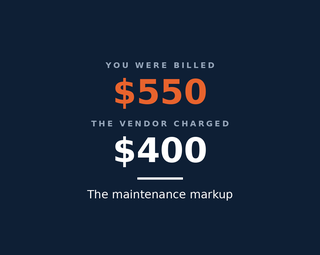
Your manager gets a call that the air conditioning is out. They dispatch a vendor. The vendor does the work and bills the manager $400. The manager then bills you $550 and keeps the difference.
From your side, the only document you ever see is a line on a statement that says something like "AC repair, $550." It looks exactly like a $550 repair. That is the whole trick.
Sometimes the arrangement is a flat percentage on every invoice. Sometimes the manager has a standing rate with the vendor that is lower than the rate the vendor would quote you directly, and the manager keeps that spread. Both produce the same result on your statement.
Why you cannot see it on your statement
This is the part worth sitting with, because it explains why so few owners ever catch it.
A statement is not evidence. It is a claim. It reports what your manager says the work cost. If the number has already been adjusted before it reaches the page, nothing downstream will reveal that. The arithmetic will all add up perfectly.
Owner portals do not help either. A nicer interface showing the same number is still the same number.
The only document that would show you anything is the vendor's original invoice, made out to the manager. If you have never seen one of those, you do not currently know what your repairs cost.
Why it is not going away on its own
Three things keep this practice alive, and none of them are going to change.
Maintenance is unpredictable. You have no baseline. A $550 air conditioning repair might be completely reasonable. You genuinely cannot tell, and neither can most owners.
Most owners are not local. You cannot call the three companies in the area and compare, because you do not know who the three companies are.
Any single instance is too small to fight. One hundred and fifty dollars on one repair never feels worth a difficult conversation with the person holding your keys. That is exactly what makes it durable. It is only ever visible in aggregate, across a year, across a portfolio, and by then it has already happened.
The other places margin hides
Repairs are the largest one, but they are not the only one. When you are asking questions, ask about all of these:
- Turnover and cleaning. If the cleaner is paid $90 and you are billed $130, that is the same mechanism with a different label.
- Supplies and linens. Consumables get replaced constantly, individually cost little, and are almost never itemized against a receipt.
- Preferred vendor arrangements. A vendor who pays for the referral has to recover it somewhere, and the only available source is your invoice.
- Administrative and coordination fees. These are fine when disclosed. The question is whether you were told.
In fairness, coordination is real work
We should be straight about something, because a version of this article that says all margin is theft would be both unfair and wrong.
Dispatching a vendor at eleven at night, meeting them at the property, checking the work, chasing the warranty claim, and rescheduling the guest is real labor. It has a cost. A manager who does that well deserves to be paid for it.
The problem is not that managers are compensated. It is that you were not told how.
A manager who says "we add fifteen percent to vendor invoices to cover coordination, and it is in section four of your agreement" is doing nothing wrong. You can evaluate that, price it, and compare it. A manager whose number simply appears on a statement has taken the decision away from you.
Disclosure is the whole issue. Not the fee.
Three questions to ask any manager
Ask these of anyone you are considering, and of anyone you already use. They take about thirty seconds.
- Do you mark up vendor invoices? Ask for a yes or a no, not an explanation.
- Will I see the original vendor invoice, or only your statement?
- On a larger project, how exactly are you compensated, and is that number in writing?
A manager who answers all three plainly is probably worth hiring, whatever the answers turn out to be. One who becomes vague on the first question has already answered it.
Watch for the deflections. "Everyone does it that way" is not an answer. "It is all in the agreement" is not an answer unless they will point to the clause. "We get you better rates than you could get yourself" may well be true, and is still not an answer to whether there is a markup on top.
How to check your own statements this week
If you already have a manager and would rather just find out, this takes one afternoon.
Pick the three largest repair line items from the last twelve months. Ask your manager for the vendor's original invoice for each. Not a summary, not a screenshot of the portal. The invoice the vendor issued.
Then call the vendor and ask what they billed for that job at that address. Vendors answer this question. They have no reason not to.
Three data points will tell you what you need to know. If the numbers match, you have a manager who passes costs through, and you should stop worrying about it. If they do not, you now know the size of it and can decide what to do.
Where we stand, so you can run the same test on us
It would be cheap to publish all of that and then be vague about ourselves. So:
We do not mark up vendor invoices. We are a licensed General Contractor, which means we hire labor directly rather than subcontracting to someone who marks it up before it reaches us. The actual cost is what reaches your statement.
On larger projects we charge a flat, disclosed fee. Ten percent when no permits are required, up to twenty percent when they are, because permitted work carries real liability and a great deal more administration. That number is agreed in advance and it is in writing. You see every invoice underneath it.
Our license numbers, so you can verify rather than take our word:
- Certified General Contractor, CGC1541671
- Certified Pool and Spa Contractor, CPC1461727
- Community Association Manager, CAM62770
All three are searchable by name or number on the Florida Department of Business and Professional Regulation website. "Certified" rather than "Registered" means the license is valid statewide rather than in one local jurisdiction. Check them. That is what they are for.
Why a pool is the clearest example
Pools are where this matters most in South Florida, and they are the reason the pool license is worth having alongside the general one.
Pool work is high ticket, it is permit heavy, and a failed heater or a cracked line is one of the most common expensive problems at a rental here. It is also the category where an owner has the least idea what anything should cost.
A resurfacing job quoted through a manager who subcontracts it carries at least one margin, sometimes two. Holding the pool license ourselves means the work is priced as the work, and the only thing on top is the disclosed project fee you already agreed to.
The incentive underneath all of this
We do not pass costs through because we are generous. We do it because of how we get paid.
Our management fee grows when your revenue grows, and in no other circumstance. That is the only incentive we want to have, because it is the only one that stays pointed the same direction as yours for as long as we work together.
A manager who earns on repairs has a quiet interest in there being repairs. We would rather not have that interest at all.
Ask us the three questions. Then go ask everyone else, and compare the answers rather than the brochures.
Current as of September 2026. License numbers verified against the Florida DBPR license search on 23 September 2026.